
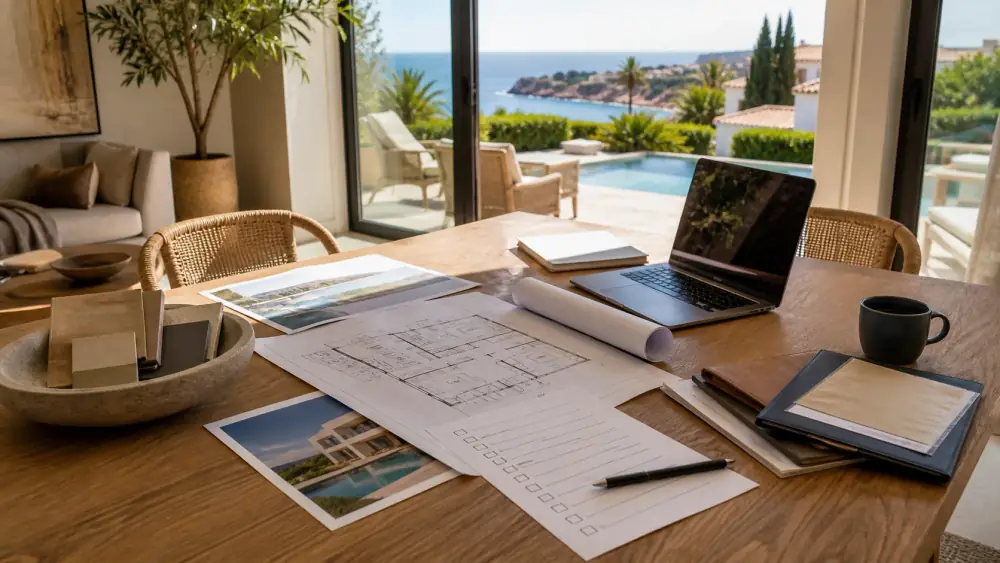
Most interior renovations in Portugal do NOT require a building permit. Painting walls, replacing kitchen cabinets, installing new flooring, retiling a bathroom and updating fixtures are all exempt from any permit requirement. However, structural changes, facade alterations and extensions absolutely do need a permit -- and carrying out unlicensed work can result in fines from 500 to 200,000 EUR, demolition orders, and criminal liability. This guide explains exactly which permits you need (if any), how to get them, and what has changed under the new 2026 rules.
The 3 Types of Renovation Permits in Portugal
Portuguese construction law classifies all renovation work into three categories, each with different requirements for permits and notifications. Understanding which category your project falls into is the first step to staying legal and avoiding costly fines.
1. Isencao (Exempt)
Works that do not alter the building's structure, facade, or use. No notification to any authority is required. You can start immediately.
2. Comunicacao Previa
A notification submitted to the Camara Municipal (city council). You can start work after the notice period (typically 20-30 days) unless the council objects.
3. Licenca de Obras
A formal building licence granted by the Camara Municipal after review of architectural and engineering plans. Required for structural changes, extensions and facade alterations.
The legal framework is defined primarily by the RJUE (Regime Juridico da Urbanizacao e Edificacao), last updated by Decreto-Lei 10/2024 which came into effect on 1 March 2024 and introduced significant simplifications that remain in force in 2026. We will cover these changes in detail below.
Works That Do NOT Need a Permit (Isencao)
The good news for most homeowners is that the majority of interior renovations are completely exempt from any permit requirement. You do not need to notify anyone -- you can simply hire your contractor and begin work. The following types of renovation fall under the exemption, provided they do not alter the building's structure, external appearance, or intended use.
- Interior painting and decorating: All painting work on interior walls and ceilings. This includes changing colours, applying decorative finishes (stucco, texture), and repainting woodwork. No restrictions on scope.
- Replacing flooring: Removing old tiles, laminate or parquet and installing new flooring, provided you are not altering the floor level or substrate structure. Includes underlayment, levelling compound and new surface.
- Replacing fixtures and fittings: Swapping toilets, basins, bathtubs, shower trays, taps, light fixtures, switches and sockets. Also includes replacing doors, door handles and window hardware (not the window frames themselves).
- New kitchen cabinets (same layout): Replacing kitchen cabinets and countertops without moving plumbing connections. As long as the sink, dishwasher and gas connections stay in their current locations, no permit is required.
- Bathroom retiling: Removing existing wall and floor tiles in a bathroom and installing new tiles. Includes reapplying waterproofing membrane behind the new tiles.
- Replacing water heater or boiler: Swapping a gas or electric water heater in the same location. Includes upgrading to a solar thermal system or heat pump if no external unit is visible from the street.
- Exterior painting (same colour): Repainting exterior walls in the same colour scheme that currently exists. If you want to change the colour, you may need approval from the Camara, particularly in historic centres.
- Roof repair (same materials): Replacing broken roof tiles with the same type and colour. Repairing leaks and replacing underlayment under the existing roof covering.
- Garden landscaping: Planting, paving, installing irrigation, and building garden walls under 1.8 metres in height that are not visible from a public road.
Important nuance: Even exempt works must comply with building regulations (RGEU) and fire safety standards. Your contractor should ensure all work meets current code, particularly for electrical and gas installations, which must be certified by qualified technicians regardless of permit status.
Works That Need Prior Notice (Comunicacao Previa)
A Comunicacao Previa is a formal notification submitted to your local Camara Municipal. It is not a permit request -- you are informing the council of your intended works, and they have a set period (typically 20-30 days) to review and potentially object. If no objection is raised within the notice period, you may proceed. The following works require this notification.
- Moving internal non-structural walls: Removing or repositioning partition walls that do not bear any load. For example, opening up a kitchen to a living room by removing a plasterboard or brick partition wall, or creating a new bedroom by dividing an existing large room.
- Changing plumbing layout: Moving the location of a bathroom, kitchen sink, or any water/drainage connection to a different position within the property. Adding a new bathroom where one did not previously exist.
- Complete electrical rewiring: A full replacement of the electrical system, including a new consumer unit (quadro eletrico) and circuit layout. Minor additions (adding outlets, replacing light switches) are exempt, but a complete rewire that changes the circuit design needs notification.
- Installing air conditioning units: External condenser units that are visible from a public road or that alter the building's facade. In heritage zones, even internal split units may require notice if the external unit is visible.
- Replacing windows (same size): Swapping existing windows for new ones of the same dimensions. If you change the window size, material (e.g., wood to aluminium) or colour, a full permit may be required, particularly in heritage areas.
- Installing solar panels: Rooftop photovoltaic or solar thermal systems. Under the 2024 simplifications, residential solar installations under 700W are exempt, but larger systems need a Comunicacao Previa.
- Building a swimming pool: New pools require a Comunicacao Previa to the Camara Municipal, including a technical drawing showing the pool's location, dimensions and drainage plan.
- Exterior painting (new colour): Changing the colour scheme of the building's exterior requires prior notice, as it alters the visual character of the streetscape. The Camara may have specific colour palette requirements, especially in historic centres.
Cost of a Comunicacao Previa
Municipal fees for a Comunicacao Previa typically range from 200 to 500 EUR, depending on the Camara and the scope of work. If you need a technical drawing from an architect, add 500-1,500 EUR for simple layouts. The entire process takes 20-30 days from submission.
Works That Need a Full Building Permit (Licenca de Obras)
A Licenca de Obras is the most comprehensive (and most time-consuming) permit category. It requires formal application to the Camara Municipal with full architectural drawings signed by a licensed architect and, where applicable, structural engineering calculations signed by a licensed engineer. The council reviews the application and either approves, requests modifications, or rejects it. You cannot begin any work until the licence is formally granted.
- Structural alterations: Any work that affects load-bearing walls, columns, beams, foundations or the building's structural frame. This includes opening doorways in structural walls, removing walls between rooms if they are load-bearing, and adding or enlarging openings.
- Facade alterations: Any change to the external appearance of the building -- new windows or doors of different sizes, adding or removing balconies, changing the roofline, adding external staircases, or modifying the building's outline.
- Extensions and additions: Adding new floor area to the building -- whether horizontal (ground-floor extension) or vertical (adding a storey). Even a small extension of 10 m2 requires a full licence.
- Change of use: Converting a building from one use to another -- for example, converting a commercial space into a residential apartment, or converting a residence into a hotel or Alojamento Local with more than 9 rooms.
- Heritage zone work: Any renovation work (even interior) on buildings classified as Imoveis de Interesse Publico, Monumentos Nacionais, or located within their protection zones. In the Algarve, this affects areas of Silves castle, Tavira old town, Faro's Cidade Velha and Lagos' historic centre.
- Demolition: Partial or complete demolition of a building or significant structural element. Even demolishing a garage or outbuilding requires a licence.
- New construction: Building any new structure, including standalone garages, guest houses, and significant garden structures (over 10 m2).
Cost of a Licenca de Obras
Municipal fees range from 500 to 2,000 EUR depending on the project scope and Camara. Architect fees add 2,000-8,000 EUR for residential projects. Engineering calculations add 1,000-3,000 EUR. Total cost including all professional fees: typically 3,500-12,000 EUR. Timeline: 45-90 days minimum, often longer.
Fines for Unlicensed Work: 500-200,000 EUR
The financial consequences of carrying out unlicensed renovation work in Portugal are severe and have been increased in recent years. The RJUE establishes a graduated fine system based on the gravity of the violation and whether the offender is an individual or a company.
Fine Schedule for Unlicensed Works
| Violation | Individual | Company |
|---|---|---|
| Works without Comunicacao Previa | 500 - 10,000 EUR | 1,500 - 45,000 EUR |
| Works without Licenca de Obras | 2,500 - 100,000 EUR | 5,000 - 200,000 EUR |
| Works in heritage/protected zones | 5,000 - 150,000 EUR | 10,000 - 200,000 EUR |
| Exceeding approved plans | 1,000 - 50,000 EUR | 3,000 - 100,000 EUR |
| Occupying without Licenca de Utilizacao | 500 - 20,000 EUR | 1,500 - 50,000 EUR |
Beyond fines, the Camara Municipal has the legal power to order the demolition of any unlicensed works at the property owner's expense. This is not theoretical -- demolition orders are regularly enforced, particularly in coastal areas and heritage zones. Additionally, unlicensed works cannot be registered in the property's Caderneta Predial, which means they do not add legal value to the property and will create problems when you try to sell.
For expats, there is an additional risk: if you are selling a property that has undergone unlicensed structural modifications, the buyer's solicitor will identify the discrepancy between the Caderneta Predial and the actual building during due diligence. This can delay or collapse the sale entirely, or force you to retrospectively apply for a licence (a process called legalizacao) which can take 6-18 months and cost 5,000-20,000 EUR in professional fees.
The New 2026 Rules: Decreto-Lei 10/2024 Simplifications
Decreto-Lei 10/2024, which came into force on 1 March 2024, introduced the most significant simplification of Portuguese construction law in decades. These changes remain fully in effect in 2026 and have made the permit process considerably faster and less bureaucratic. Here are the key changes that affect renovation projects.
- Digital platform (Plataforma Eletronica): All permit applications and Comunicacoes Previas can now be submitted digitally through a centralised online platform. No more physical trips to the Camara Municipal with paper documents. The system generates automatic receipts and tracks processing deadlines.
- Expanded exemptions: More categories of work are now exempt from any permit. Interior alterations that do not affect structure are explicitly excluded from licensing requirements, codifying what was previously interpreted inconsistently by different Camaras.
- Tacit approval (Deferimento Tacito): If the Camara fails to respond within the legally mandated timeframe, the application is automatically approved. Previously, silence from the council could leave projects in limbo indefinitely. This is a game-changer for renovation timelines.
- Reduced processing times: The legal deadline for Comunicacao Previa review has been tightened to 20 working days. Licenca de Obras decisions must be issued within 45 working days for standard residential projects, though complex projects or those requiring external consultation (IGESPAR for heritage, APA for environment) may take longer.
- Simplified technical requirements: The Termo de Responsabilidade (declaration of responsibility) signed by the architect and engineer now carries more weight, reducing the council's need for detailed technical review. This places more liability on the professional signatories but speeds up approval.
- Solar panel exemptions: Residential solar photovoltaic installations up to 700W are now completely exempt from any permit or notification. Larger residential systems (up to 30 kW) require only a simplified Comunicacao Previa.
Practical impact: For a typical expat renovation in the Algarve -- replacing a kitchen, renovating bathrooms, new flooring and painting throughout -- the new rules confirm that you almost certainly need zero permits. For a renovation that includes opening up rooms by removing a partition wall and reconfiguring plumbing, you will need a Comunicacao Previa which can now be submitted online and resolved in 20-30 days. This is a significant improvement over the pre-2024 system where the same process could take 3-6 months.
Algarve-Specific Rules: POOC, Heritage Zones and Coastal Restrictions
The Algarve has several location-specific restrictions that go beyond the standard national permit rules. These are enforced by regional authorities in addition to the local Camara Municipal, and failing to comply with them can result in particularly harsh penalties including demolition orders.
POOC -- Coastal Zone Restrictions
The Plano de Ordenamento da Orla Costeira (POOC) imposes strict building controls on properties within the coastal strip (typically 500 metres to 2 km from the coastline, depending on the specific section). Properties in Carvoeiro, parts of Lagos marina area, and the Praia da Rocha zone of Portimao fall within POOC areas.
- -- Height restrictions: Buildings cannot exceed specified heights (varies by zone)
- -- Building footprint limits: Maximum lot coverage percentages apply
- -- Setback requirements: Minimum distances from cliff edges and the high-water mark
- -- Additional approvals: Projects may require APA (Agencia Portuguesa do Ambiente) sign-off in addition to the Camara
- -- No new construction: In some POOC sub-zones, no new buildings are permitted at all -- only renovation of existing structures
Heritage Zones (Zonas de Protecao)
The Algarve has numerous classified heritage sites with surrounding protection zones where stricter rules apply. Any renovation within these zones -- even interior work that would normally be exempt -- may require approval from DGPC (Direcao-Geral do Patrimonio Cultural).
- -- Silves: Castle and old town centre. All works within the protection zone require DGPC consultation.
- -- Tavira: Historic centre including the old bridge area. Strict controls on facade materials, colours and window styles.
- -- Faro: Cidade Velha (old walled town). Even interior renovations may need approval if the building is listed.
- -- Lagos: Historic centre near the Praca Gil Eanes. Specific colour palette and material requirements for facades.
- -- Loulé: Historic market area and old town. Restrictions on external signage and facade modifications.
How to check: Before starting any renovation in the Algarve, verify whether your property falls within a POOC zone, heritage protection zone, or REN/RAN (ecological or agricultural reserve) area. Your contractor or architect can check this through the Camara Municipal or using the Sistema Nacional de Informacao Territorial (SNIT) online mapping tool. At RenovAlgarve, we perform this check as part of our initial site survey for every project.
How Long Do Permits Take?
Permit processing times vary by Camara Municipal and by project complexity. Here are the realistic timelines you should plan for in 2026, based on our experience across the Algarve.
| Permit Type | Legal Deadline | Realistic Timeline | Preparation Time |
|---|---|---|---|
| Isencao (exempt) | None | 0 days | N/A |
| Comunicacao Previa | 20 working days | 20-30 calendar days | 1-2 weeks |
| Licenca de Obras (simple) | 45 working days | 45-90 calendar days | 3-6 weeks |
| Licenca de Obras (complex) | 45+ working days | 90-180 calendar days | 4-8 weeks |
| Heritage zone (DGPC consultation) | 60+ working days | 120-240 calendar days | 6-12 weeks |
Preparation time refers to the period needed to gather documents, prepare architectural drawings, and compile the application before submission. For a Comunicacao Previa, this might be as simple as a technical drawing and a description of works. For a full Licenca, it includes architectural plans (planta de arquitetura), structural calculations (projeto de estabilidade), thermal and acoustic studies, and various technical declarations.
The Algarve Camaras with the fastest processing times are generally Lagoa and Lagos. Portimao and Albufeira tend to have longer processing times due to higher volumes of applications. However, the 2024 digital platform has improved consistency across all municipalities.
The Permit Process Step by Step
Whether you need a Comunicacao Previa or a full Licenca de Obras, here is the typical process from start to finish.
- Step 1 -- Determine the permit type: Your contractor or architect assesses the scope of work and determines whether you need an isencao, Comunicacao Previa, or Licenca de Obras. They also check for heritage zone, POOC and REN/RAN restrictions.
- Step 2 -- Gather documents: Caderneta Predial (property registration), Certidao Permanente (land registry), topographic survey (if required), and proof of ownership. Your NIF (tax number) is essential.
- Step 3 -- Prepare technical documents: The architect prepares drawings (plantas) showing the existing layout and proposed changes. For a Licenca, a structural engineer may also be needed to produce stability calculations. All documents must be signed by qualified professionals registered with the Ordem dos Arquitectos or Ordem dos Engenheiros.
- Step 4 -- Submit application: Submit via the digital platform (Plataforma Eletronica) with all documents, drawings, Termos de Responsabilidade signed by the architect/engineer, and proof of payment of municipal fees.
- Step 5 -- Review period: The Camara reviews the application. They may request additional information (pedido de elementos) which restarts the clock. Responding promptly to information requests is crucial for avoiding delays.
- Step 6 -- Decision: The Camara approves, requests modifications, or (rarely) rejects the application. For a Comunicacao Previa, silence equals approval. For a Licenca, you receive a formal alvara (licence document).
- Step 7 -- Post-completion: After works are complete, a Licenca de Utilizacao (occupancy licence) may be required if the building's use has changed. Your architect submits the completion documentation and the Camara may inspect.
Condominium Permissions: An Extra Layer for Apartment Owners
If your property is part of a condominium (edificio em propriedade horizontal), there is an additional layer of permissions beyond government permits. Portuguese condominium law (Codigo Civil, Artigo 1422) requires that certain types of work receive approval from the condominium assembly (assembleia de condominios) before you can proceed.
Works affecting common areas (entrance halls, stairwells, building facade, roof, shared plumbing risers) always require condominium approval, typically by a two-thirds majority vote at a formal assembleia. Even works that only affect your own apartment -- such as moving plumbing that connects to shared risers, or removing a wall that is adjacent to a neighbour's unit -- may require notification or approval.
Before starting any renovation in a condominium, check the Regulamento do Condominio (condominium rules) for specific renovation restrictions. Some condominiums limit noisy work to specific hours (typically 9:00-18:00 weekdays), require a refundable deposit to cover any damage to common areas during the renovation, and mandate that contractors carry public liability insurance.
How RenovAlgarve Handles Permits for You
Navigating the Portuguese permit system as an expat can feel overwhelming, particularly if you do not speak Portuguese or are managing the project from abroad. At RenovAlgarve, permit management is included in our standard project service. Here is exactly what we do.
- Initial assessment: During our free site visit, we determine exactly which permits (if any) your project requires. We check for heritage zones, POOC restrictions, REN/RAN designations, and condominium rules. We give you a clear, written answer.
- Architect coordination: If your project needs an architect or engineer, we work with our network of licensed professionals to prepare all required drawings and technical documents. Costs are included in our quote with no hidden mark-ups.
- Application submission: We submit all applications through the digital platform and handle all communication with the Camara Municipal on your behalf. You do not need to visit any government office or write a single document in Portuguese.
- Progress tracking: We monitor the application status and respond immediately to any information requests from the council. We keep you updated at every stage via email and WhatsApp.
- Material ordering during permit period: We use the permit waiting period productively by ordering materials, coordinating subcontractor schedules, and preparing so that construction can begin the moment the permit is granted.
This service is included in all RenovAlgarve projects at no additional management fee. You pay only the actual costs: Camara Municipal fees, architect/engineer fees (if needed), and any required certifications. We handle the rest. Use our online calculator to get a preliminary estimate of your renovation costs, including permit fees where applicable.
Essential Documents You Will Need
Regardless of which permit type applies to your project, you will need certain documents. Having these ready before you begin saves significant time. Here is the complete checklist.
- NIF (Numero de Identificacao Fiscal): Your Portuguese tax number. Non-EU citizens need a fiscal representative. Cost: 100-250 EUR for a fiscal representative.
- Caderneta Predial: Property registration certificate from Financas. Shows the registered description, area and fiscal value. Available online at Portal das Financas. Cost: free.
- Certidao Permanente: Land registry certificate from the Conservatoria. Confirms ownership and any encumbrances. Cost: 15-25 EUR online.
- Architectural drawings (if required): Existing and proposed floor plans, elevations and sections. Must be signed by a registered architect. Cost: 1,500-8,000 EUR depending on complexity.
- Termo de Responsabilidade: Declaration of responsibility signed by the architect and/or engineer taking professional liability for the project. Required for all Comunicacoes Previas and Licencas.
- Contractor details: The contractor's IMPIC licence number, insurance certificates, and Alvara (construction licence). RenovAlgarve provides all these documents as standard.